
Did your ancestors make the news?
Many record groups used by genealogists are documents created under the direction of a government or church organization. They have regular rules they follow, and you can quickly learn what to expect from them. For example, the U.S. Census has been taken every ten years since 1790 and each entry in them has the same kind of information.
Historical newspapers tend to break the mold as a record group—with not only diversity of content but also a multitude of sources that need to be used harmoniously for a researcher to feel confident that all the bases have been covered and enough evidence has been gathered to constitute genealogical proof.
What to Look for in Historical Newspapers for Genealogy
Like any genealogical search, a newspaper search starts by formulating a specific goal and then using “time and place”—the time frame of your research and the geographic place in which it happened. Consider all the different items that could appear in newspaper pages—from business openings and “who visited who” social columns (which were the nineteenth century’s social media!) to estate sales and other legal notices. Your ancestor may have even made the front page—be sure to check the news articles themselves.
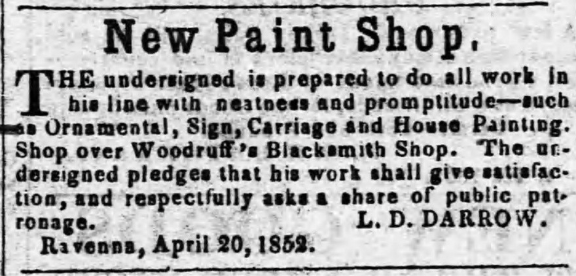
Check out my ancestor, Lorenzo D. Darrow, who opened a paint shop in Ravenna, Ohio, and posted an ad for his business in the local newspaper. He later suffered property loss in a fire, which also made local news.
“New Paint Shop,” Portage Sentinel (Ravenna, Ohio), 3 May 1852, p. 3; Newspapers.com (https://www.newspapers.com/: accessed 27 January 2026).
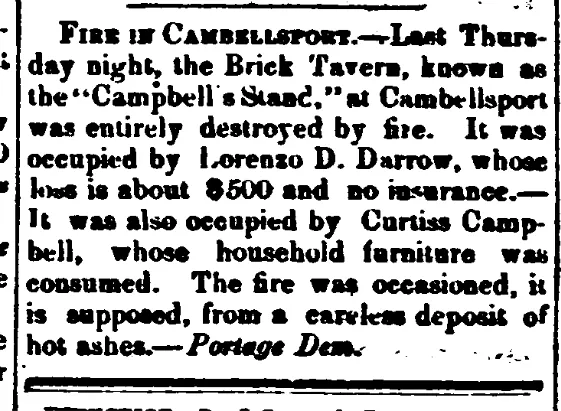
“Fire in Cambellsport,” Western Reserve Chronicle (Warren, Ohio), 16 January 1856, p. 3; GenealogyBank (https://www.genealogybank.com/: accessed 27 January 2026).
When it comes to recordings of death, realize that newspapers can provide more than the standard obituaries. There may also be paid death notices, with more or less information than the obituary. A person’s passing may be mentioned by a columnist, or an unusual manner of death may have warranted an article. Death notices vary greatly in what information they provide.

“Died.,” Democratic Press (Ravenna, Ohio), 28 August1873, p. 2; Newspapers.com (https://www.newspapers.com/: accessed 27 January 2026).
These two death notices provide very different information about Ida Siddall and Lois Darrow.
Newspapers sometimes noted other vital events in people’s lives, such as listing marriage licenses or divorce filings brought before the local court, or even the occasional birth announcement congratulating the new parents.
Consider what events in your ancestor’s life might have made the news and search accordingly, framing by time, place, and name. Or try a wider search of the entire time period your ancestor may have lived in a certain area, to catch things you may not expect.
Where to Find Historical Newspapers Online for Genealogy Research
You can start by examining free collections of digitized historical newspapers, which may require an account or library card.
- Chronicling America, a collection from the Library of Congress
- CommunityHistoryArchives.com
- State newspaper project websites
- Local library websites
- Legacy.com, a website that houses more recent obituaries
- Google News Archive
You’ll then want to look at what paid sites have for your time period and geographic area of interest as a way of determining whether they are worth the subscription price for you to invest. The major sites include:
- Newspapers.com
- GenealogyBank.com
- NewspaperArchive.com
There’s been an absolute explosion of historical newspaper pages being made digital and searchable with optical character recognition technology (OCR). Online newspaper archives continue to digitize and provide OCR for more and more historical newspapers. If you haven’t had luck searching in the past, try again!
Newspapers.com is still adding content to their website in 2026
How to Find Historical Newspapers That Are Not Online
If you’ve exhausted basic searches—or if you want to be more methodical from the start—you can use the Directory of U.S. Newspapers in American Libraries (found at the Library of Congress website) or WorldCat (with more up-to-date listings than the directory if your time of interest is close to the present day) to create a definitive list of all the possible newspapers to seek out through free, subscription, or publishers’ websites—every one that was published in the times and places related to your ancestor.
And digitized newspapers are only the starting point—there are plenty of newspapers that still haven’t been digitized that you can access offline. The Directory of U.S. Newspapers might guide you to a local library’s physical collection of historical newspapers for their area. Librarians might even conduct a search for you if you can’t make the trip. Use their specific library’s website to learn how to reach out.
Use the Directory of U.S. Newspapers or WorldCat to see library holdings of newspapers on microfilm or in paper form. You should also seek out published and unpublished abstracts of events and clippings scrapbooks from newspapers; many unpublished abstracts can be found in county historical and genealogical libraries.
The Library of Congress provides both the Directory of U.S. Newspapers in American Libraries AND a free newspaper collection called Chronicling America on their website.
How to Use Newspaper Records in Your Genealogy Research
Now that you’ve identified your ancestor in a newspaper clipping, consider how the clipping helps you achieve your genealogical goals. Whether you were just looking to know more about your ancestor’s life or trying to make that breakthrough into the next generation, newspapers might just contain the information you need, although you might need to combine your clipping with other genealogical sources, like census and vital records, to draw your conclusions.
Remember my ancestor Lorenzo D. Darrow who opened a paint shop in 1852? This is him in the 1870 U.S. Census, where his occupation was “House Painter.”
1870 United States Census, population schedule, Farmington, Trumbull County, Ohio, p. 21, household of Lorenzo D. Darrow; Ancestry (https://www.ancestry.com/: accessed 27 January 2026).
Want help using newspapers to make that next breakthrough? Reach out and we’ll work together to find out if we’re a good fit for you and your research goals!
my nephew and me have done the family Tree/ history and have come to a standstill as we believe that my Grandmother was an illegitimate of the Duke of Marlborough the 7th but unable to get to the finale part how can we get the truth if only we could get a DNA that would confirm it
Hi Nancy! Someone from our team will reach out to see how we can further assist you!
Hello Hannah. There’s a connection beyond what I know, I feel it. It involves a big case in Idaho, and for me to get this sudden info about my 3rd generation grandfather is beyond shocking to me. And I know it goes deeper I need ur help
Hi Melanie! Someone from our team will reach out to see how we can further assist you!