
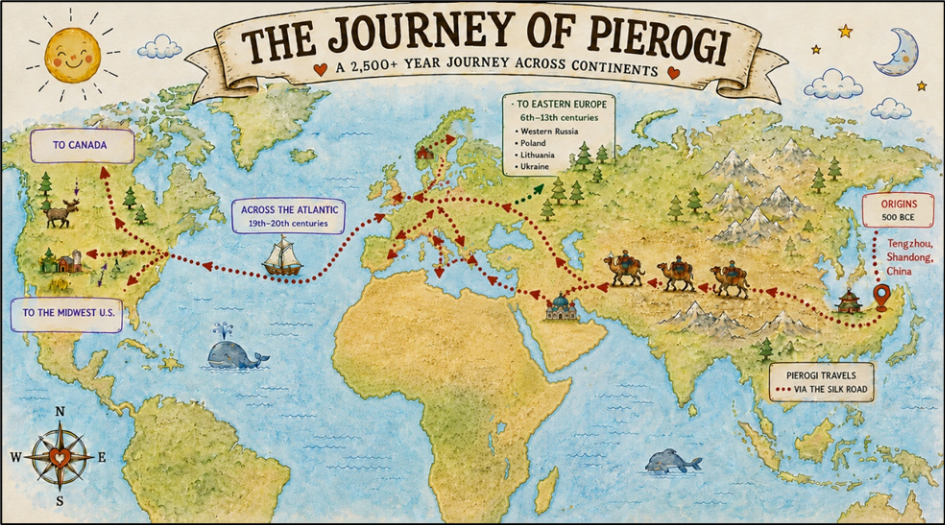
Map created with ChatGPT
Food can be one of the strongest links we have to our ancestors. A handwritten recipe, a holiday dish, or even the way a grandmother folded dough can preserve pieces of family history long after the people who began those traditions are gone.
For millions of families with roots in Poland and Eastern Europe, pierogi are one of those connections.
While cultures around the world have developed their own variations of filled dough, pierogi have become a distinct cultural icon with a deep heritage rooted in Eastern Europe. Their story stretches across centuries, cultures, migration routes, and eventually oceans.
Understanding the history of pierogi offers more than a glimpse into culinary history. It can also help us understand how traditions traveled with our ancestors and became part of the family stories we preserve today.
Where Did Pierogi Originate?
The exact origin of pierogi is difficult to pinpoint.
The word “pierogi” is connected to the Proto-Slavic word pir, associated with a “feast” or “festivity,” reflecting the important role these foods eventually played in celebrations and special occasions.
Traditional pierogi are generally made from wheat-based, unleavened dough wrapped around a filling and boiled in water. They may then be sautéed in butter or fat and served with fried onions, sour cream, or other accompaniments.
Pierogi became particularly associated with areas once belonging to the Polish-Lithuanian Commonwealth and neighboring regions of Eastern Europe. But the larger story of the filled dumpling stretches much farther east.
Ancient Dumplings and the Silk Road
Long before pierogi became a Slavic staple, people were making filled dough pockets elsewhere in Eurasia.
Some of the earliest archaeological evidence of dumpling-like foods comes from ancient China. In 1978, archaeologists excavating a tomb in Tengzhou, Shandong Province, reportedly discovered triangular food remains dating to approximately 500 BCE. The discovery provides evidence that filled dough foods have existed for more than 2,000 years.
Over centuries, different forms of filled dough appeared throughout Central Asia, the Middle East, and Europe.
The Silk Road and other migration and trade routes likely played an important role in the exchange of culinary traditions. Nomadic Turkic and Mongol peoples prepared filled dumplings that could be practical travel foods, while Central Asian manti and Chinese jiaozi developed their own distinct traditions.
These dishes should not necessarily be considered pierogi themselves. Instead, they demonstrate how the simple idea of wrapping a filling inside dough appeared and evolved across many cultures.
Did Marco Polo Bring Dumplings to Europe?
One popular story claims that Venetian merchant Marco Polo encountered filled dumplings in China and introduced them to Europe when he returned in 1295.
The historical evidence does not support such a simple origin story.
Forms of pasta and filled dough existed in Europe and the Mediterranean before Marco Polo’s travels. Arab influence in medieval Sicily, for example, contributed to the development and spread of pasta traditions in the Mediterranean.
Rather than tracing every European dumpling to a single traveler or place, it is more accurate to view filled dough as a culinary idea that developed and traveled through centuries of migration, trade, and cultural exchange.
For genealogists, that story may sound familiar. Cultural traditions rarely remain confined to modern borders. People move, communities interact, and traditions change along with them.
How Pierogi Became a Polish Tradition
The migrating dumpling eventually found one of its most famous homes in Poland.
According to Polish legend, Saint Hyacinth, or Święty Jacek, helped popularize pierogi after traveling through Kievan Rus in the thirteenth century.
One story tells of a devastating hailstorm that destroyed crops near Kościelec. After Saint Hyacinth prayed for the harvest, the crops were miraculously restored, and villagers prepared pierogi in thanksgiving.
His association with the dish became so strong that the Polish expression “Święty Jacku z pierogami!” roughly translates to “St. Hyacinth and his pierogi!” and has traditionally been used as an exclamation of surprise.
Whatever their precise route into Poland, pierogi eventually became deeply embedded in Polish food culture.
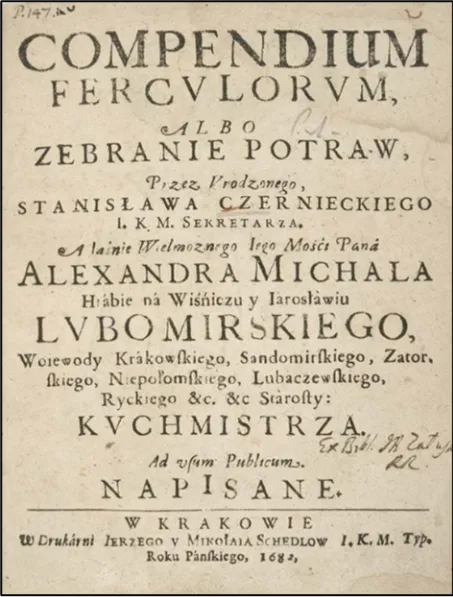
One of the earliest known written Polish pierogi recipes appeared in the 1682 cookbook Compendium Ferculorum by Stanisław Czerniecki. The cookbook included sophisticated fillings intended for wealthy households, including ingredients such as kidneys, veal fat, and greens.
As ingredients and agricultural practices changed, so did pierogi.
After potatoes became widely cultivated in Eastern Europe, potato-based fillings became increasingly common. One of the best-known varieties today is pierogi ruskie, traditionally filled with potatoes, farmer’s cheese, and onions.
Despite what the name might suggest to modern English speakers, ruskie historically refers to Ruthenia rather than Russia, reflecting the intertwined histories of the peoples and territories of Eastern Europe.
Pierogi and Polish Holiday Traditions
Pierogi are more than everyday food. For many Polish families, they are closely connected to holidays, family gatherings, and religious traditions.
They are particularly important during Wigilia, the traditional Polish Christmas Eve supper.
Because Wigilia traditionally excludes meat, families may serve pierogi z kapustą i grzybami, filled with sauerkraut and mushrooms. Another related dumpling, uszka, meaning “little ears,” is commonly filled with mushrooms and served in barszcz, a clear beet soup.
These traditions can become valuable pieces of family history.
If your grandparents or great-grandparents made pierogi for Christmas Eve, for example, the fillings they chose, the holidays on which they served them, and even what they called them may offer clues about where your family lived or which cultural traditions influenced them.
Pierogi’s Close Relatives Across Eastern Europe
Modern national borders do not always reflect the world our ancestors knew.
For centuries, borders throughout Eastern Europe shifted as empires expanded, countries disappeared and reemerged, and communities of different languages and religions lived alongside one another.
That complicated history is reflected in food.
Ukraine: Varenyky
Ukrainian varenyky are closely related to Polish pierogi and can contain potatoes, cheese, cabbage, meat, or sweet fillings such as sour cherries.
They also hold symbolic significance in Ukrainian culture and have been associated with prosperity, family celebrations, and traditional customs.
Russia: Vareniki and Pelmeni
Russian vareniki share similarities with pierogi, while pelmeni represent another dumpling tradition. Pelmeni are generally smaller, have thinner dough, and traditionally contain meat.
Their ability to be frozen made them particularly practical in Siberian climates.
Lithuania and Belarus: Koldūnai and Kalduny
Lithuanian koldūnai and Belarusian kalduny are often smaller dumplings filled with meat, mushrooms, or other savory ingredients. Their similarities to neighboring dumpling traditions reflect centuries of cultural exchange within the Polish-Lithuanian Commonwealth and surrounding regions.
Slovakia: Pirohy
Slovak pirohy closely resemble pierogi and are commonly filled with ingredients such as bryndza, a distinctive sheep’s milk cheese strongly associated with Slovak cuisine.
Hungary: Derelye
Hungarian derelye may contain cottage cheese, jam, or savory fillings and have traditionally been associated with home cooking and special occasions.
Romania and Moldova: Colțunași
Colțunași are filled dumplings that may contain cheese, meat, jam, or other ingredients and can be boiled or baked.
Bosnia and Serbia: Klepe
Klepe are typically small meat-filled dumplings served with sour cream or a garlic-yogurt sauce and paprika.
These regional variations illustrate an important principle in genealogy: culture rarely follows a perfectly straight line.
An ancestor from Kraków and an ancestor from Sarajevo might both have grown up eating filled dough dishes, yet called them different names, used different fillings, and associated them with entirely different traditions.
Pierogi Come to America
During the nineteenth and early twentieth centuries, millions of immigrants from Central and Eastern Europe crossed the Atlantic in search of work, land, religious freedom, and new opportunities.
They brought their food traditions with them.
Polish, Ukrainian, Slovak, Lithuanian, and other Eastern European immigrants established communities throughout industrial cities such as Pittsburgh, Cleveland, Detroit, Buffalo, and Chicago, as well as mining towns and farming communities across the United States and Canadian Prairies.
Within these immigrant communities, food helped preserve a connection to home.
Pierogi could be made inexpensively with readily available ingredients, but their importance extended beyond practicality. Families gathered to roll dough, prepare fillings, and pinch hundreds of dumplings together. Churches and cultural organizations incorporated pierogi into festivals and fundraisers.
Over generations, recipes changed.
In North America, for example, potato and cheddar became a particularly popular filling, reflecting the availability of ingredients and changing tastes.
Today, pierogi remain part of community life in many areas shaped by Eastern European immigration. Pittsburgh even celebrates this heritage through Major League Baseball’s famous Great Pierogi Race, featuring characters such as Sauerkraut Saul and Cheese Chester.
What Can a Family Recipe Tell You About Your Ancestry?
For genealogists, perhaps the most interesting part of the pierogi story is not determining who invented the first dumpling.
It is understanding how traditions travel with people.
Family recipes can provide clues about migration, ethnicity, religion, geography, and community.
If pierogi, varenyky, pirohy, or another dumpling has been passed down in your family, consider asking:
- What did your family call the dish?
- Who taught the recipe to the next generation?
- Was it associated with Christmas, Easter, weddings, or another celebration?
- What fillings did your family traditionally use?
- Did your ancestors belong to a Polish, Ukrainian, Slovak, Lithuanian, Ruthenian, or other Eastern European community?
- Did the recipe change after your family immigrated?
- Was it prepared at home, at church, or during community gatherings?
Even small details can become part of a larger genealogical picture.
A grandmother who called the dish varenyky rather than pierogi, for example, does not establish ancestry by itself. But combined with passenger lists, church records, census records, naturalization papers, and information about the family’s neighbors, cultural traditions can add context to the documentary record.
Other Filled Dough Traditions Around the World
Pierogi belong to a much larger global family of foods built around the idea of enclosing a filling inside dough.
Examples include:
- Germany: Maultaschen, large pasta pockets traditionally filled with meat, spinach, breadcrumbs, and herbs.
- Italy: Ravioli, pasta parcels containing cheese, herbs, meat, vegetables, or other fillings.
- France: Ravioles, small filled pasta particularly associated with the historic Dauphiné region.
- Spain and Latin America: Empanadas, baked or fried pastries containing an enormous variety of savory or sweet fillings.
- Turkey and Central Asia: Manti, small dumplings traditionally filled with seasoned meat and served in several regional styles.
- China: Jiaozi, dumplings with a history stretching back centuries and a particularly important role in Lunar New Year traditions.
Although these foods should not all be considered versions of pierogi, their histories demonstrate something universal: people carry food traditions wherever they go.
Food Is Part of Your Family History
A recipe may not appear on a census record or immigration document, but it can still tell a story.
The history of pierogi reflects more than 2,000 years of human movement, cultural exchange, adaptation, and tradition. Its journey also mirrors the journeys genealogists uncover every day: people crossing borders, establishing communities, preserving pieces of their homeland, and adapting old traditions to new lives.
That is why food can be such a meaningful starting point for family history research.
The pierogi your grandmother made may have changed considerably from those prepared generations earlier in Eastern Europe. But the tradition itself can represent an unbroken connection between your family’s past and present.
And sometimes, following a family tradition backward can lead you toward the people and places that started it.
Explore Your Eastern European Family History
Do family traditions, recipes, or stories point toward Polish, Ukrainian, Lithuanian, Slovak, or other Eastern European ancestry?
Professional genealogy research can help connect those traditions to the historical record. Legacy Tree Genealogists’ worldwide network of researchers can investigate immigration records, church registers, civil records, historical documents, and archives to help uncover where your ancestors lived and the lives they built.
If you’re ready to learn more about the people behind your family’s traditions, contact Legacy Tree Genealogists to discuss your research goals.
Leave a Reply