
DNA ethnicity results can be exciting, confusing, and sometimes unexpected. Many people open their results expecting to see only known family origins, only to find small percentages from regions they have never heard of. These surprising DNA segments can reflect distant ancestry, population overlap, or limitations in how testing companies interpret genetic data.
Understanding how DNA segments are inherited and analyzed helps turn unexpected results into meaningful clues. In some cases, these small segments can even help identify a previously unknown ancestor.
Ethnicity estimates are not based on family stories or surnames. They are based on pieces of your DNA that testing companies compare to reference groups. Once you understand how DNA segments are inherited and interpreted, unexpected results become much clearer. Sometimes they reflect a real distant ancestor. Sometimes they reflect deep population history. Sometimes they reflect the limits of the testing company’s model. And sometimes, when paired with segment analysis and family history research, they can become useful clues for identifying a mystery ancestor.
Why Do Unexpected DNA Ethnicity Results Appear?
Unexpected DNA ethnicity results are one of the most common questions in genetic genealogy. You inherit autosomal DNA from both parents, but not in neat, predictable portions from each ancestor. Before it is passed down, DNA is shuffled through recombination, creating a random mix of segments. Over generations, those segments become smaller, so distant ancestors may leave behind only tiny fragments of DNA.
If one of those fragments resembles a modern reference population, it may be labeled as that ethnicity, even if the ancestor lived many generations ago. Human populations have also mixed for centuries, so neighboring regions often share similar DNA. This can lead to ethnicity results being assigned to related areas such as Greek, Balkan, or Mediterranean.
Unexpected DNA ethnicity results can also be caused by a misattributed parent or ancestor, where the biological parent differs from the documented family line. In these cases, DNA may introduce a geographic origin that does not match known family history.
In short, there are several reasons why surprising DNA segments appear in ethnicity estimates. DNA segment analysis can help determine whether a small or unexpected percentage reflects distant ancestry, population overlap, or a more recent family connection.
Why Do DNA Ethnicity Estimates Differ Between Companies?
DNA ethnicity estimates can vary between testing companies because each one uses different reference populations, region definitions, and algorithms to interpret your DNA.
Each company compares your DNA to its own dataset, which means results depend on how that data is grouped and labeled. For example, one company may separate Scotland and Ireland, while another combines them into a single region.
Algorithms also differ. Some companies prioritize broader, more stable regions, while others offer more detailed breakdowns that may be less consistent.
Ethnicity estimates can also change over time as companies update their data and refine their methods. These updates reflect improved interpretation of your DNA, not changes in your genetic makeup.
Are Small DNA Ethnicity Percentages Accurate?
Small DNA ethnicity percentages (typically under 5%) should be interpreted with caution. They may reflect real ancestry, but they are rarely strong evidence on their own.
A small percentage can represent DNA from a distant ancestor, especially if the same DNA segments appear in multiple relatives. When this pattern is consistent, it becomes more reliable.
However, in DNA segment analysis, very small segments are more likely to be misleading. They can reflect shared population DNA or technical noise rather than a true inherited connection.
For this reason, genealogists treat small ethnicity percentages as clues, not conclusions. These results become meaningful only when supported by additional evidence such as shared matches, family trees, or triangulated DNA segments.
Can DNA Segments Identify Specific Ancestors?
DNA segments cannot identify a specific ancestor on their own, but they can help pinpoint a family line when combined with genealogical research.
Ethnicity Estimates vs. DNA Segments
An ethnicity estimate shows that part of your DNA resembles a population. A shared DNA segment with living matches can provide more useful information, such as which branch of your family that DNA came from.
How Triangulation Connects DNA to a Family Line
When multiple people share the same DNA segment in the same location on a chromosome and descend from the same ancestral couple, that segment can often be assigned to that ancestral line. This process is known as triangulation and is one of the most reliable methods in genetic genealogy for connecting DNA evidence to a specific family.
Why DNA Evidence Must Be Combined with Research
DNA segment analysis must be combined with documented relationships, clustering, and traditional genealogical research. For example, if you and several matches share an overlapping segment and all descend from the same set of great-great-grandparents, that segment likely came from that ancestral line.
Using DNA Segments to Identify Unknown Ancestors
This approach is especially valuable in cases involving unknown parents or mystery ancestors. If a group of matches all share DNA with each other and trace back to a family you do not recognize, they may represent the branch where an unknown parent, grandparent, or earlier ancestor belongs.
By analyzing shared matches, building family trees, and comparing DNA segments, genealogists can narrow the possibilities and identify likely connections.
Case Study: Where Did the Unexpected African Ethnicity Come From?
My father’s known family tree included a mixture of 100 percent European ancestors, so his ethnicity results, which included 2.1 percent Sub-Saharan African admixture, came as a big surprise.
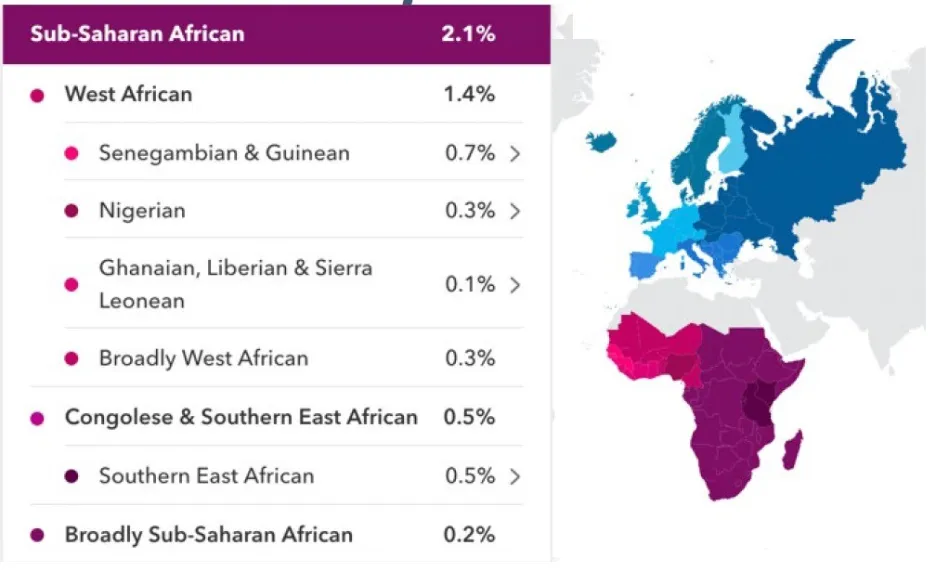
DNA segment analysis proved that his African ethnicity was not just a small, isolated percentage on an ethnicity report, but part of a real inherited family line. Triangulation research revealed that all the DNA matches who share his African DNA segments descend from a Price couple who lived in Missouri after the Civil War.
The next step was to connect this Price family to our known genealogy. Careful research revealed that the Price family lived in close proximity to my third-great-grandmother, Martha “Jennie” Gibson, whose parentage had long been unknown. While no direct record identifies her parents by name, the DNA evidence strongly supports that she was the daughter of Mrs. Price, who was enslaved at the time of Jennie’s birth. Additional shared DNA segments with descendants of her likely enslaver further strengthen this conclusion and provide a strong argument for the identity of both of Jennie’s parents.
On its own, the small African percentage could have been dismissed as uncertain. However, through DNA segment analysis and traditional research, it became the key to resolving a long-standing family mystery.
From Unexpected DNA Results to Real Answers
Unexpected ethnicity results are common and usually have discoverable explanations. A small percentage may reflect distant ancestry, population overlap, or statistical uncertainty, so it shouldn’t be overinterpreted or ignored. The key is to look beyond the percentage. Focus on shared matches, test relatives, build family trees, and use tools like triangulation alongside traditional records. When used carefully, DNA segments can turn surprising results into meaningful clues, helping uncover hidden branches and identify mystery ancestors.
How to Interpret Surprising DNA Segments
- Analyze shared DNA matches
- Test additional relatives
- Build out family trees
- Use triangulation to connect segments
- Compare results across testing companies
Turning DNA Clues Into Family History Answers
When used carefully, DNA segment analysis can turn surprising DNA segments into meaningful clues. These insights can help uncover hidden branches in your family tree and identify mystery ancestors that traditional records alone may not reveal. In some cases, these methods can provide the missing piece needed to identify an unknown parent or confirm a long-standing family mystery.
Work With a Professional Genealogist
Interpreting DNA results, especially small or unexpected segments, often requires advanced analysis and experience. If you are trying to understand surprising DNA segments or identify a mystery ancestor, working with a professional can help you move forward with confidence.
At Legacy Tree Genealogists, our team combines DNA segment analysis with traditional research to uncover answers that are not immediately visible in ethnicity results alone.
Ready to explore your DNA results?
Contact our team to get started and take the next step toward understanding your family history.
I needed this. Thanks for sharing.
Glad we could help!