
Your Ancestor Worked in an Industrial Town: What That Means for Your Research
Why Did Families Move to Industrial Towns?
- Transportation Corridors: Industrial migration closely followed rail lines and river corridors that linked rural areas directly to manufacturing hubs.
- Immigrant Destinations: Passenger lists and arrival records frequently listed a contact or final destination pointing straight to an industrial settlement.
- Chain Migration: Relocation usually occurred in stages. A single worker or young couple moved first to secure work and housing before extended family followed. This creates clusters of related families from the same place of origin in industrial census records.
How Company Towns Impacted Surviving Records
Alternative Sources for Company Town Research
- Company Payroll Records: Reveal wage levels, job titles, dates of employment, and time worked.
- Housing and Tenancy Registers: Document family composition, household members, and address histories within company-owned housing.
- Store Account Books & Credit Ledgers: Offer evidence of daily purchases and local presence.
- Scrip Records: Trace transactions made using company-issued currency.
***Note on Preservation: These business-focused records vary widely in survival. While some are preserved in regional archives or local historical societies, many were lost when companies dissolved.
Religious & Church Records
Why Do Records From Industrial Towns Seem to Disappear?
Local Enumerations & School Censuses
District-level records provide valuable snapshots between federal census years. For example, early 20th-century school census records in mining hubs—such as Cochise County, Arizona—capture both school-age children and broader neighborhood networks.

Workplace Disasters & Inaccurate Records
- Record Loss: Industrial fires, mine floods, and factory explosions frequently destroyed local record repositories or scattered surviving documents.
- Newspaper Coverage: Disaster reports in historical newspapers are critical resources that often list disaster victims, survivors, and community support efforts.
Informant Inaccuracies: Death certificates and accident reports were often filled out by employers, foremen, or acquaintances rather than family, leading to incomplete or incorrect biographical data.
What Key Records Should You Search For?
- Union Records: Surviving union collections may contain membership rolls, dues ledgers, correspondence, meeting minutes, and death benefit applications. Look for these collections in university archives, state historical societies, or the Library of Congress.
- Workers’ Compensation & Injury Reports: As early 20th-century labor laws developed, state labor departments and local courts recorded detailed workplace injury reports containing medical profiles, employer statements, and family dependencies.
- Post-1906 Naturalization Records: Declarations of intent and petitions for naturalization after 1906 contain precise birthplaces, arrival details, and witness affidavits from coworkers, neighbors, and relatives.
- Foreign-Language Newspapers: Industrial centers supported rich immigrant press networks. Foreign-language publications reported on local births, marriages, workplace accidents, and obituaries omitted from mainstream English papers.
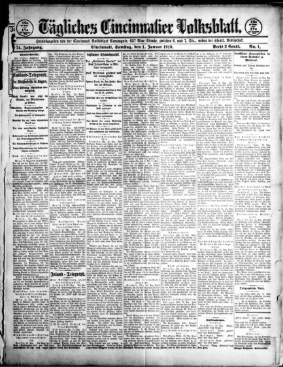
Tägliches Cincinnatier Volksblatt (Cincinnati, Ohio), 1 January 1910, p. 1; Library of Congress (https://www.loc.gov/resource/sn83045474/1910-01-01/ed-1/?sp=1&st=image&r=-0.757,-0.072,2.513,1.441,0: accessed 19 March 2026)
What Occupation Entries Reveal About Your Ancestors
- Textile Mills: Roles ranged from lower-skilled machine operators to highly skilled mechanics and overseers.
- Iron & Steel Works: Heavy labor jobs like “puddling” demanded extreme physical exertion and specialized experience under harsh conditions.
- Child Labor Patterns: Children were widely employed in mines, glass works, and textile mills prior to early 20th-century labor reforms. If a child is missing from school records but lives in an industrial household, check for workplace listings.

How to Proceed When the Genealogy Trail Runs Cold
When records seem to disappear, it can help to shift your approach. Instead of focusing only on the individual, start with the industry. Identify the company or type of work your ancestor was involved in, then research that industry’s history:
- When did the company operate?
- Where were its facilities located?
- Were its records preserved?
From there, expand outward. Study neighbors, coworkers, and extended family members, known as the FAN network (friends, associates, and neighbors). Following those connections often reveals patterns that are not visible when focusing on a single individual. Industrial communities moved quickly, changed frequently, and did not always leave behind complete records. But those gaps are not random. They reflect how people lived and worked. Understanding that context does more than explain missing records; it points you toward new ones.
Need expert help untangling complex record trails or tracing hard-to-find relatives? Our team of professional genealogists would be happy to help—contact us today to get started on your family history research.
Very interesting blog on work records. My great grandfather was an unpleasant man who would not show his skills to bosses nor would he train juniors. His name was William Meadley (1844-1917) He is remembered in our family as the man who got our grandfather’s birth date wrong by weeks because he was drunk when he went to register it. He was a Railway engineer. It has been hard finding any good features of the man.That said his wife Eliza was a lovely woman and well remembered. Strange isn’t it?
What an interesting family story. It’s amazing how the details passed down through generations can bring our ancestors’ personalities to life, for better or worse! William certainly sounds like a complicated character, especially alongside the much warmer memories of Eliza. Stories like these are a great reminder that family history isn’t always neat or flattering, but those human details can make our ancestors feel all the more real. Thank you for sharing!
My maternal grandmothers father and a sister worked in a silk mill in Dushore. The family later moved to Wilkes Barre where they continued this work. I also have ancestors who worked in the coal mines of Luzerne and Carbon county.
What a wonderful connection to this topic! Your family’s history in the silk mills and coal mines offers such a fascinating glimpse into the industries that shaped communities across Pennsylvania. Those work records may hold some interesting clues about their lives and movements, especially from Dushore to Wilkes-Barre. Thank you for sharing your family’s story with us!