
Tracing your family history often begins as a personal hobby, but for many it evolves into a professional pursuit. As the industry has grown, so has the framework of genealogy organizations that support it. For someone looking to hire a researcher or enter the field, the alphabet soup of acronyms—APG, BCG, ICAPGen, NGS—can be overwhelming. If you’re trying to understand the difference between genealogy organizations like APG, BCG, and ICAPGen—or wondering whether a genealogist is truly qualified—this guide will break it down clearly.
There are several major genealogy organizations, each serving a different role. How can a person know which ones guarantee high-quality research? Understanding these organizations is more than just learning names; it is about understanding the standards that protect the integrity of family history research.
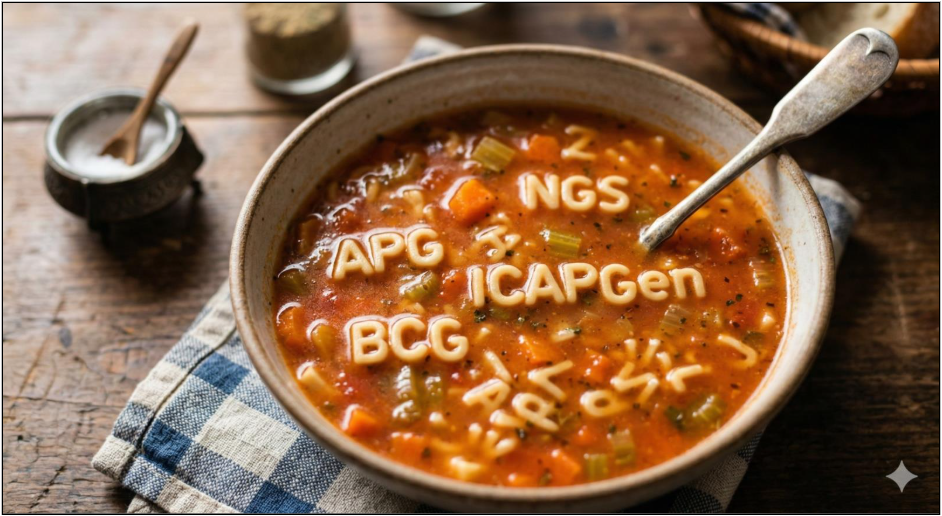
The alphabet soup of APG, BCG, ICAPGen, and NGS. Image generated by AI.
What Are Professional Genealogy Associations?
Professional genealogy associations are organizations that support, educate, or evaluate genealogists. Some focus on community and learning, while others test and certify a researcher’s skills. Understanding the difference helps you determine whether a genealogist is simply involved in the field or formally qualified.
Why Are There So Many Genealogy Organizations?
There are multiple genealogy organizations because no single group oversees the entire field. Some focus on education, others on ethics, and others on testing professional competence. Together, they create a system that supports both learning and quality standards. The world of genealogy is vast, covering everything from local record preservation and DNA analysis to complex legal heirship cases. No single entity could effectively govern every aspect of the field. Instead, different organizations have evolved to serve specific niches:
- Professional trade groups: Focus on the business and ethics of being a genealogist
- Educational groups: Focus on teaching researchers how to improve their skills
- Credentialing bodies: Focus on testing and verifying a researcher’s competence
By having distinct organizations, the field ensures a system of checks and balances. One group might teach you how to research, while another tests whether you learned the material to a professional standard.
Membership vs Certification vs Accreditation (What’s the Difference?)
Before diving into the specific groups, it is vital to clarify a common point of confusion: the difference between membership and credentials. Membership means a genealogist has joined an organization, usually for education or networking. Certification and accreditation, however, require rigorous testing and evaluation of actual research work. In short, membership shows participation, while credentials prove ability.
Membership
Anyone can join a membership-based organization by paying annual dues. Membership organizations do not require a test of skill or a review of work samples. Being a member of a prestigious group shows the person has an interest in the field and provides access to the group’s resources. However, membership in a group does not provide a “seal of approval” regarding the quality of a member’s research.
Credentials (Certification, Accreditation or Degree)
Credentials must be earned. They are not granted based on a fee, but rather on a rigorous peer-review process. A credentialed genealogist has submitted their work to be evaluated by experts to prove they meet high standards of evidence, logic, and documentation.
Key takeaway: If a genealogist lists an organization on their resume, check whether they are a “member” (they paid to join) or are “board-certified/accredited” (they passed a difficult exam).
Quick Comparison of Major Genealogy Organizations
The main genealogy organizations each serve a different purpose, from education to professional standards to credentialing. Comparing them side by side makes it easier to understand what each one actually represents. This helps you quickly identify which qualifications matter when choosing a genealogist.
Organization | Type | Acronyms to Look For | Primary Goal |
APG | Trade association | Member of APG | Ethics & business standards |
NGS | Educational | Member of NGS | Skills development & community |
BCG | Credentialing | CG® | Testing general research mastery |
ICAPGen | Credentialing | AG® | Testing regional research mastery |
The Major Players: A Breakdown
To choose the right professional or educational path, you need to know what each major group brings to the table.
1. Association of Professional Genealogists (APG): What It Means
The Association of Professional Genealogists (APG) is a membership-based organization focused on ethics and professionalism. Members agree to a code of ethics, but they are not required to pass a skills assessment. This means APG membership reflects commitment to the field, not verified expertise.
- Primary role: Professional trade association.
- What they do: APG focuses on the business side of genealogy. They advocate for high ethical standards and provide a directory of genealogists to help clients find researchers.
- Focus: Ethics and professionalism. All members must sign a strict Code of Ethics. While APG does not test its members’ research skills, they do provide a grievance process if a member violates their ethical agreement.
2. National Genealogical Society (NGS): Education and Community
The National Genealogical Society (NGS) is an educational organization that helps genealogists build and refine their research skills. It offers courses, publications, and conferences for all experience levels. Like APG, membership does not indicate certification or professional qualification.
- Primary role: Education and advocacy.
- What they do: NGS is one of the largest member organizations in the United States. They provide extensive webinars, a major annual conference, and a monthly magazine.
- Focus: Education. They are a teaching organization. They help hobbyists become professionals and help professionals stay sharp. Like APG, NGS is a membership organization; joining does not mean a person is “certified.”
3. Board for Certification of Genealogists (BCG): The CG Credential Explained
The Board for Certification of Genealogists (BCG) awards the Certified Genealogist® (CG®) credential through a rigorous evaluation process. Applicants must submit a portfolio demonstrating research accuracy, analysis, and documentation. This credential signals proven competence and adherence to professional standards.
- Primary role: Credentialing body.
- What they do: BCG is the entity that awards the Certified Genealogist® (CG®) credential. To earn this credential, a researcher must submit a portfolio of original research, document their proof arguments, and pass a rigorous evaluation.
- Focus: Standards and testing. They set the genealogy standards used across the industry. When you see “CG” after a name, it means that person’s work has been judged and approved by their peers.
4. International Commission for the Accreditation of Professional Genealogists (ICAPGen): What Accredited Genealogist Means
ICAPGen grants the Accredited Genealogist® (AG®) credential, which tests expertise in a specific geographic region. Candidates must pass multiple exams and complete research projects focused on that region’s records. This ensures both research skill and deep regional knowledge.
- Primary role: Credentialing body.
- What they do: ICAPGen awards the Accredited Genealogist® (AG®) credential. Their process is unique because it tests a researcher’s expertise in a specific geographic region (e.g., New England, Germany, or the Mid-Atlantic).
- Focus: Regional expertise. The accreditation process involves multiple levels of testing, including a proctored exam and a research project focused on a specific area’s records and history.
5. Various Colleges and Universities
- Primary role: Education and Expertise Testing
- What they do: In order to achieve a degree in genealogy, a student takes a variety of classes and then must pass exams and/or review processes to prove expertise.
- Focus: Methodology, standards, testing.
In Simple Terms:
- APG = ethics & professional network
- NGS = education
- BCG = certification (CG)
- ICAPGen = accreditation (AG)
Why Genealogy Credentials Matter to Clients
Genealogy credentials matter because they verify a researcher’s ability to produce accurate, evidence-based conclusions. They also ensure adherence to established standards like the Genealogical Proof Standard. This helps protect against errors that could lead to incorrect family histories. When you hire a professional for a project—whether for a home renovation or a legal case—you look for licensing and certification. Genealogy is no different.

Image courtesy pexels.
Because family history research involves interpreting old handwriting, navigating fragmented records, and solving complex DNA puzzles, the margin for error is high. A single mistake in identity can lead to an entire tree of “ancestors” who aren’t actually related to you.
Credentials provide three main layers of protection:
- Objectivity: A credentialed researcher follows a standard of proof that requires exhaustive research and thoroughly analyzed evidence.1 This prevents research shortcuts that result in errors.
- Accountability: All research by credentialed professionals is conducted in strict accordance with the Genealogical Proof Standard (GPS). We operate under a professional code of ethics that prioritizes evidence-based conclusions and high-caliber reporting for our clients.
- Efficiency: Experienced, credentialed researchers often work faster because they know exactly which records to check and which archives are likely to hold the answers, potentially saving the client money in the long run.
For professional firms like Legacy Tree Genealogists, aligning with these standards is a core part of the business model. By employing researchers who are either credentialed or adhere strictly to the standards set by these organizations, a firm ensures that the stories and lineages they provide are backed by solid evidence rather than guesswork.
Do You Need a Certified or Accredited Genealogist?
You do not always need a credentialed genealogist, but credentials provide added confidence in the quality of work. Certified or accredited professionals have been tested against industry standards. For complex or high-stakes research, credentials can significantly reduce risk. The world of professional genealogy is supported by a network of organizations designed to educate, regulate, and certify.
- NGS and APG provide community, ethics, and education.
- BCG and ICAPGen and various colleges and universities provide rigorous testing that proves a researcher’s skill.
Whether you are a student of genealogy looking to sharpen your skills or a person looking to hire a professional genealogist, understanding these organizations can help ensure that your family history research is accurate, ethical, and built to last for generations.
A Simple Way to Hire a Qualified Genealogist
If navigating genealogy credentials feels overwhelming, working with a professional research firm, like Legacy Tree Genealogists, can simplify the process. Established firms align with industry standards and employ experienced researchers. This allows you to focus on results without needing to evaluate qualifications on your own.
If you need assistance with your genealogy and are ready to hire an experience professional to help, contact us to talk about options.
Resources:
Association of Professional Genealogists (https://www.apgen.org/: accessed 27 February 2026).
National Genealogical Society (https://www.ngsgenealogy.org/: accessed 27 February 2026).
Board for Certification of Genealogists (https://www.bcgcertification.org/: accessed 27 February 2026).
International Commission for the Accreditation of Professional Genealogists (https://icapgen.org/: accessed 27 February 2026).
Citations:
Sora Shimazaki, “Cheerful colleagues shaking hands while standing at table,” photograph; pexels (https://www.pexels.com/photo/cheerful-colleagues-shaking-hands-while-standing-at-table-5673497/: accessed 27 February 2026).
As a beginner family tree researcher, the article was excellent.
We are glad to hear that! Thanks Randy and good luck with your research journey!
Perhaps you can add RQG to the list? The Register of Qualified Genealogists.
Especially when one of the headings is “A Simple Way to Hire a Qualified Genealogist”
https://www.qualifiedgenealogists.org/
Hi John, great suggestion! We will definitely look into this! We love supporting all genealogists!