
If you have a parent, grandparent, or an even earlier ancestor born in Canada, you may now qualify for Canadian dual citizenship by descent. Thanks to recent updates under Bill C-3, Canada has expanded eligibility, making it easier than ever for Americans to claim Canadian citizenship.
Now is the Time to Claim Your Canadian Dual Citizenship
Due to Canada’s Bill C-3, An Act to Amend the Citizenship Act, passed on December 15, 2025, there has never been, and may never be, an easier path to Canadian dual citizenship. These reforms rectified confusing and often discriminatory regulations of the past and greatly expanded and simplified the process of claiming Canadian citizenship by descent.
According to Colin R. Singer, a licensed Canadian immigration attorney and managing partner of the law firm Immigration.ca, Bill C-3 automatically and retroactively recognizes citizenship for descendants of those born before the bill’s passage. If, for example, your great-grandparent was a citizen of Canada, their right of citizenship is retroactively passed along, generation by generation, to you. Remarkably, Singer notes that the bill imposes no limitation on the number of generations through whom this right may be passed down.
Straightforward Example. Born in the State of Montana, I’m a United States citizen. My maternal grandfather, Eric Forwood, was born in British Columbia in 1910 and, with his parents, migrated a few hundred miles south to Montana in 1923. Under these new regulations, the only certificates (long-form, which show parents’ names) now needed for me to claim Canadian citizenship are:
- Grandpa’s Canadian birth certificate,
- My mother’s U.S. birth certificate,
- Mom’s U.S. marriage certificate confirming her change of surname,
- My U.S. birth certificate,
- My U.S. marriage record confirming my change of surname.
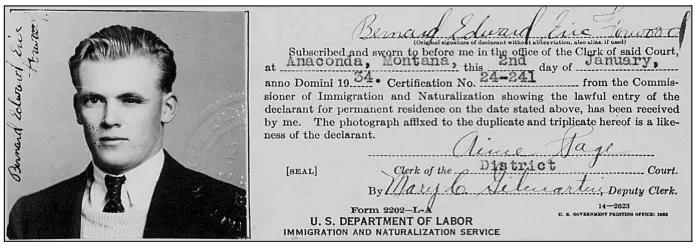
Section of Eric’s 1934 U.S. citizenship application.
Why Get Canadian Dual Citizenship?
In addition to peace of mind and a meaningful connection to Canada and its people, there are several practical benefits to obtaining Canadian dual citizenship. Singer also highlights the following advantages available to dual U.S.-Canada citizens:
- Live and work in Canada without a visa or work permit
- Access Canadian education at domestic tuition rates for yourself or your children
- Utilize Canada’s public healthcare system once residency is established
- Hold a Canadian passport, allowing visa-free travel to more than 180 countries
- Vote in Canadian elections, if desired
- Sponsor family members for immigration to Canada
- Pass Canadian citizenship by descent to your children born after the passage of Bill C-3
Application Process for Canadian Citizenship by Descent
The application process for Canadian citizenship by descent is not unlike applying for a mortgage loan or preparing itemized tax forms. The first step involves gathering the required certificates, some of which may require documentation proving your relationship to a Canadian ancestor. (In my case, I’ll need to obtain my and my mother’s birth and marriage certificates to apply to British Columbia for my grandfather’s birth record.)
Immigration or travel records, such as my grandfather’s U.S. citizenship application, that support your connection to a Canadian citizen can also be helpful when applying for Canadian dual citizenship.
The process can be detail-oriented and requires persistence, but it can often be accomplished by a novice. For most applicants, gathering documents to prove Canadian citizenship eligibility may take several months and can cost a few hundred dollars to obtain certified records.
With these in hand, you can apply for a citizenship certificate through Immigration, Refugees and Citizenship Canada (IRCC). Due to the recent increase in applications following Bill C-3, current IRCC processing times for Canadian citizenship applications are approximately ten months.
Will Canadian Dual Citizenship Affect My U.S. Citizenship?
For United States citizens, the answer is no. Obtaining Canadian dual citizenship does not require you to give up your U.S. citizenship. Referencing Section 101 of the Immigration and Nationality Act, the U.S. Department of State confirms that “U.S. law does not impede its citizens’ acquisition of foreign citizenship whether by birth, descent, naturalization, or other form of acquisition.”
In other words, Americans can legally hold dual U.S.-Canada citizenship, including when claiming Canadian citizenship by descent.
Nevertheless, we recommend consulting an immigration attorney to guide you through the application process and answer any questions about your specific situation.
Are There Tax or Financial Implications of Canadian Dual Citizenship?
Mike Wallace from Greenback Expat Tax Services notes that if you are a U.S. citizen, you are still required to file U.S. federal tax returns regardless of where you live. This applies even after obtaining Canadian dual citizenship.
However, tax treaties between the United States and Canada are in place to help prevent double taxation. These agreements are designed to ensure that individuals with dual U.S.-Canada citizenship are not taxed twice on the same income.
Wallace’s blog provides helpful guidance on the tax and financial implications for Americans who move to Canada, establish residency, or open financial accounts as part of their transition after receiving Canadian citizenship by descent.
Why Apply for Canadian Dual Citizenship Now?
In this instance, waiting to apply for Canadian dual citizenship may come at a high cost. Canada’s citizenship laws have changed frequently in the past, and future updates to Canadian citizenship eligibility could impact who qualifies.
Additionally, Canada’s Parliament significantly expanded access through Bill C-3, leading to a surge in applications for Canadian citizenship by descent. CNN reported that dual citizenship inquiries and application volumes in early 2026 were 10 to 15 times higher than in previous years, with many Americans applying “just in case” of future uncertainty.
As more people become aware of their eligibility for Canadian dual citizenship, wait times for obtaining records and receiving a Canadian citizenship certificate are expected to increase.
When Records Are Difficult to Locate for Canadian Citizenship by Descent
Proving Your Canadian Ancestry
Professional genealogists like those at Legacy Tree Genealogists can help when challenges arise in proving Canadian citizenship by descent. We assist with locating records and confirming eligibility.
Since this legislation passed, we’ve worked with new clients who believe they qualify for Canadian dual citizenship but lack the documentation to prove it. This includes descendants of early Canadian ancestors, such as a First Nations ancestor believed to have been born in British Columbia in the mid-1700s.
A More Complex Example
Between 1803 and the 1880s, several generations of my paternal Stearns and Brooks ancestors migrated from New Hampshire and Vermont to Quebec, then Ontario, and eventually to Nebraska.
The challenge was proving my connection to my third great-grandfather, Hiram Stearns. He was born in Quebec in 1817 to Asa Stearns and Eunice Brooks. Establishing this link was necessary to claim Canadian citizenship by descent.
Challenges with Early Records
Hiram was born before civil registration began. At that time, church baptism and marriage records were often incomplete or missing.
I was able to locate notarial records, a French tradition used to document legal transactions. These records confirmed relationships between Hiram’s siblings and their parents. However, proving Hiram’s connection required deeper research.
Finding the Missing Link
Evidence showed that Hiram and his brother Ira owned adjacent land in Lachute, Quebec. They later migrated together to Russell, Ontario with other siblings. After extensive research, I found a notarial deed that had been incorrectly indexed. The record appeared under the name “Iram,” which could easily be mistaken for Ira. It was also misfiled under “Umes” Brooks and “Jeane” Stearns instead of Eunice Brooks Stearns. This 1838 document ultimately confirmed the family connection needed to prove lineage.
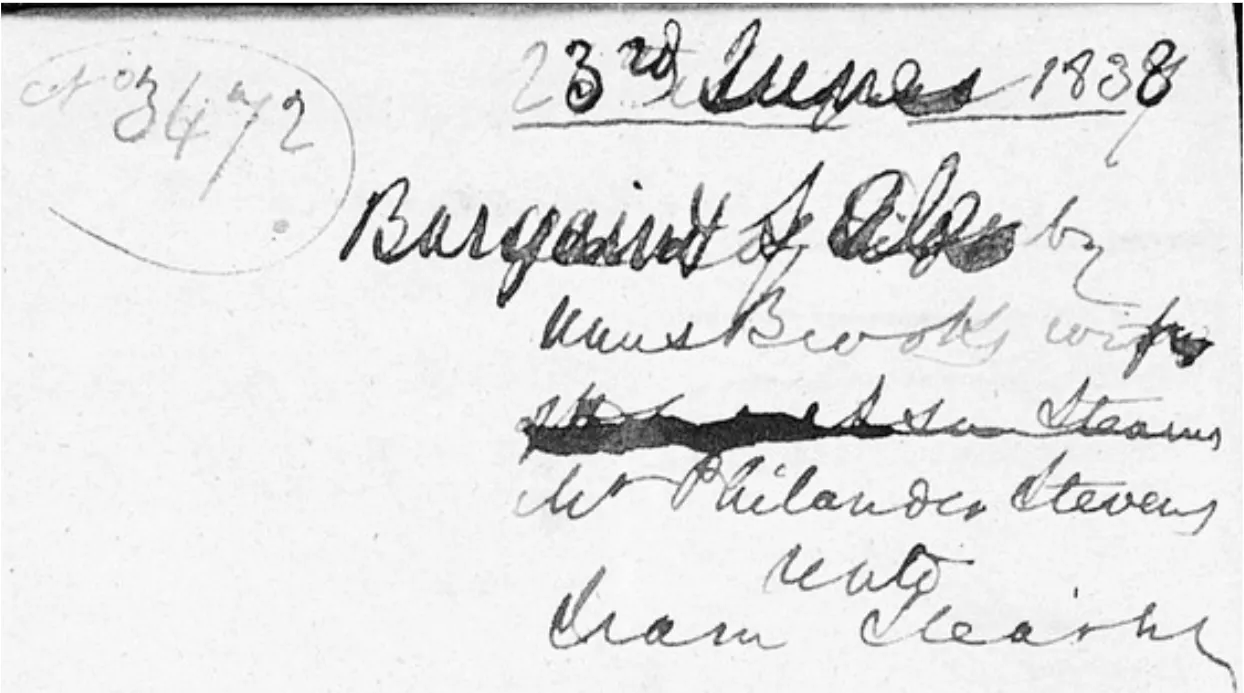
Cover page for the 1838 deed between “Unus” Brooks (wife of Asa Stearns and wife of Philander Stevens) unto “Iram” Stearns.
The deed itself confirmed that Hiram had inherited the land from his father, Asa Stearns. This connection was further supported by Hiram’s mother, Eunice Brooks, who had since married her long-time neighbor, Philander Stephens.
It is this kind of detailed and persistent research that is often required to prove Canadian citizenship by descent, especially when working with early records and incomplete documentation. Establishing these connections between generations is a critical step in confirming Canadian citizenship eligibility.
Getting Started with Canadian Citizenship by Descent
I’ll need to confirm my descent from my grandfather to obtain his birth certificate from British Columbia, so I’ll begin by ordering birth and marriage records for my mother and myself. This is often the first step in proving Canadian citizenship by descent and confirming your eligibility.
If you, like me, have ever considered applying for Canadian dual citizenship, now is the time to move that goal from your bucket list to reality.
If you’d like help confirming your connection to Canadian ancestors or gathering the records needed to apply for Canadian citizenship by descent, the team at Legacy Tree Genealogists is here to help. Contact our team today!
who do I contact to do this
Hi Joe! Someone from our team will reach out to see how we can assist you!
Hi,
I have my Great Grandfathers extract of his Baptism record. will this be enough for the Canadian record if I can not locate his birth record?
IRCC is asking for records from the original source authority, so I doubt they would accept your Grandfather’s extract. If it has information about the church where the baptism took place, I would go looking for a record issued by that church or by an archive that currently holds the church’s records.
That can be a little challenging, especially on the frontier of Canada. We would be happy to assist if you need help with that.
How do I get information about dual citizenship, if my ancestor name on a USA census shows his nationality was a Canada. His name was Thomas Williams an Indian.
Censuses are sometimes inaccurate, but if Thomas’s birthplace was recorded as Canada on a U.S. census, there’s a very good chance he (or a parent) was born in Canada. To apply for dual citizenship, you would need to gather documents from Canada that actually document his birth there. That would usually be a birth certificate or baptism record provided by the “original authority or issuing authority” in Canada (the province, the church, or the church’s archive). You would also need to obtain documentation (birth records and marriage records if there were name changes) connecting you and each of your ancestors to Thomas.
The most difficult and important record is usually for the immigrant ancestor (Thomas, in your case) since it confirms your connection to Canada. If you’re confident of your connection to Thomas, I would start with trying to locate his birth/baptism record first. In general, the other generational connections will usually be easier to prove.
Of course, we’d be delighted to help with any phase of your research!