
The end-of-year holidays are quickly approaching, prompting many of us to scurry about, ensuring our homes are ready to celebrate meaningful traditions for another year. Many cherished holiday traditions have origins in other countries, carried by our immigrant ancestors and now celebrated generations later.
If you were to walk with me around my hometown of Lititz in Lancaster County, Pennsylvania, you would notice one special decoration gracing countless porches, treetops, and even the nativity scene on our town square: the Moravian star.
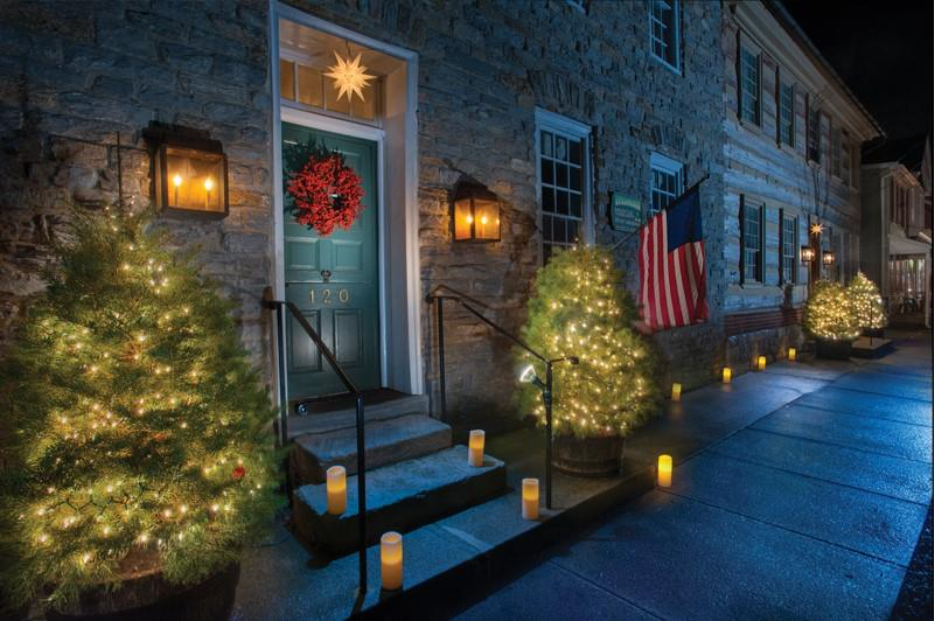
 Above photographs courtesy of Donald Reese.
Moravian Origins: Roots of Christmas Traditions
Why are Moravian stars ubiquitous in my hometown? Lititz was one of three towns in Pennsylvania founded by Moravian emigrants from Germany in the 1740s and 1750s. The roots of Moravian traditions date back to the fourteenth century when Jan Hus and his followers sought religious freedom in Moravia and Bohemia (now parts of the Czech Republic). After Hus was accused of heresy and burned at the stake in 1415, his followers eventually found safe refuge in Saxony thanks to Count Nikolaus Ludwig von Zinzendorf, where they established the village of Herrnhut. The Moravians brought their traditions with them as they created settlements in Pennsylvania, including Bethlehem, Nazareth, and Lititz (originally spelled Litiz). In fact, Bethlehem, Pennsylvania claims the first documented Christmas tree in the American colonies! Just six years after its founding on Christmas Eve 1741, Bethlehem celebrated Christmas 1747 with one large pyramid tree and two smaller pyramid trees decorated with greenery, candles, apples, and Bible verses.
 A replica of an early Moravian Christmas pyramid, predecessor of the Christmas tree. Photograph courtesy of Historic Bethabara Park, the first Moravian settlement in North Carolina.
The History of the Moravian Star in Germany
The Moravian Star tradition began in Niesky, Germany, where the earliest star was reportedly made of paper, possibly by boarding school boys, and hung outside the school during Advent in 1821. With their prominent focus on both missions and education, Moravians have long operated boarding schools. The first star was red and white, representing the blood and purity of Christ.
A significant discovery unveiled new details of the star's origins. In 2011, a translated diary entry dated 20 December 1820, revealed that Christian Madsen, a single Brother residing in the Brethren's House, created the original 110-point star specifically as a Christmas decoration for the Niesky Brethren's House. The following month, this multicolored star was displayed for the fiftieth anniversary of the Moravian boarding school in Niesky, and the school then adopted the star pattern as a geometry project.
Mathematical Foundations
The star's structure is based on a rhombicuboctahedron, a three-dimensional geometric figure with twenty-six faces: eighteen square and eight triangular, which serves as the center of a Moravian Star with twenty-six points shooting out from those faces. Evidence from Johann Arbo's 1760s geometry workbook shows precise drawings of a rhombicuboctahedron along with diagrams for making pyramid shapes out of paper. His geometric calculations provide evidence the star was in some form of development decades before Madsen’s much larger 110-point star.
Commercialization and Spread of the Moravian Star
In 1892, an unknown Prussian soldier made an advent star for his comrades, and the soldiers subsequently made eight stars that were displayed for sale in a bookbinder's window, marking the first small commercial production. In 1897, Pieter Hendrik Verbeek began serially producing Moravian Stars in Herrnhut, Germany, and in 1899 he signed a contract with the Moravian Church to sell the stars, with proceeds supporting missionary work. Verbeek improved the design from fragile construction paper to hollow metal bodies with slots for points made from paper on metal frames and eventually modernized the lighting from oil lanterns to gas and electrical lighting.
Arrival in Pennsylvania and the Lititz Connection
By the very early twentieth century, communities in Pennsylvania with Moravian roots were making and displaying these stars. A photograph from 1907 shows a Moravian Star hung inside Nazareth Moravian Church while Lititz congregants recalled a 26-point star that hung above the pulpit every Advent season. In 1980, Lititz Moravian congregation member Barney Braun presented a magnificent 110-point white star to his church, having acquired the drawings from a fellow Moravian in Königsfeld, Germany. This 58-inch star was the first of its kind hung in any Moravian Church in the United States.
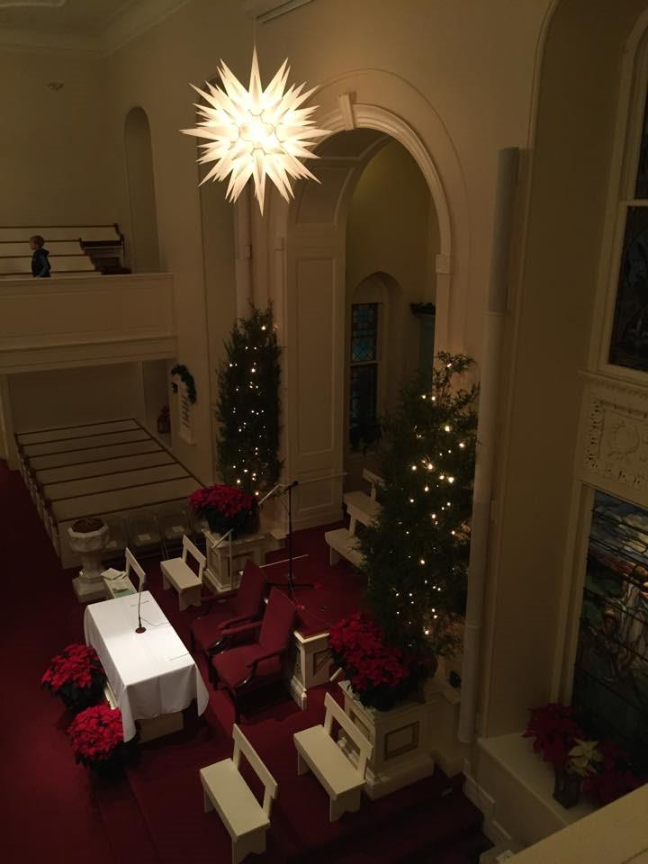 The 110-point star above the pulpit. Photograph courtesy of Lititz Moravian Church.
Originally, only Lititz Moravian families displayed stars during Advent, allowing passersby to identify Moravian households. However, as awareness of the stars' beauty grew, non-Moravians began incorporating them into their holiday decorations and now they are found all over town in homes of various religious backgrounds. The stars are traditionally hung on the first Sunday in Advent and taken down before the beginning of Lent.
Moravian Star Symbolism and Colors
The Moravian Star represents the star that led the wise men to Bethlehem and is symbolic of Jesus, who said «I, Jesus, am the bright and Morning Star» (Revelation 22:16). The red and white stars represent the life of Christ—white for the swaddling cloth wrapped around baby Jesus in the manger and red for the blood shed by Christ in his death.
By the early 1900s, paper stars were being made in yellow, red, white, and combinations of these colors. Interestingly, Lititz Moravians preferred white stars while European members favored yellow or red.
Archives and Records
How do we know so much about the history of the Moravian star? The Moravians in both Germany and America kept incredibly detailed records, including memoirs and daily diaries of the Single Brothers and Single Sisters. Those records have been well-preserved by the Moravian Archives in Bethlehem, Pennsylvania. If you have ancestors who belonged to a Moravian community, a treasure trove awaits you!
Reflect on your Holiday Traditions
In my hometown, Christmas and the Moravian Star are synonymous. What winter holiday traditions do you and your family celebrate? Do you know how they originated? Take some time to reflect on traditions that may have traveled with your immigrant ancestors. How have they evolved or how have they remained the same? Is there a tradition that has spread throughout your region like the Moravian Star has in Pennsylvania? Do a little research to uncover its origins to deepen the meaning of the holiday season!
If you'd like assistance discovering your ancestors, we'd love to help!
Fill out our form here, and we'll get the conversation going.
Sources for further information:
Thomas McCullough, Moravian Archives (Bethlehem, Pennsylvania), “The Moravian Star: Its History and Origins,” presentation, 18 November 2020; YouTube (https://www.youtube.com/watch?v=wfjC1ARt3O4: accessed 13 October 2025).
“The Mystery Surrounding the Moravian Star,” Moravian University News (https://news.moravian.edu/2024/12/18/history-moravian-star/: accessed 13 October 2025).
Charlene VanBrookhoven, “The Moravian Star,” Lititz: Our Community in Story (https://lititzstories.blogspot.com/2023/12/the-moravian-star.html: accessed 13 October 2025).
“Christmas in Lititz,” Lancaster County Magazine (https://www.lancastercountymag.com/christmas-in-lititz/: accessed 13 October 2025).
“One Dozen Firsts,” Visit Historic Bethlehem (https://www.visithistoricbethlehem.com/history/one-dozen-firsts/first-documented-christmas-tree-in-america/: accessed 13 October 2025).
Legg igjen en kommentar