
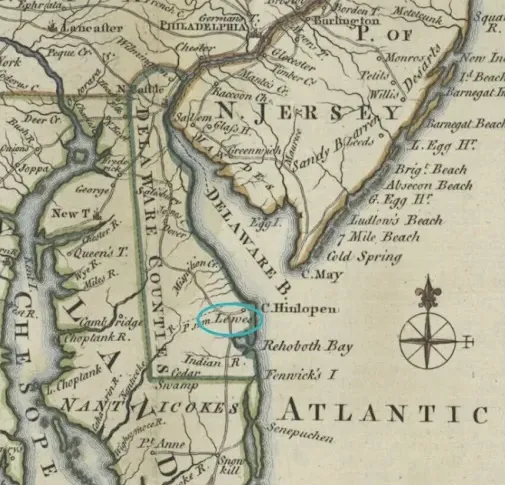
1757 map showing the location of Lewes on the Delaware Bay. Courtesy of Wikimedia Commons.1
Lewes (pronounced loo’-is), Delaware, is situated on the Delaware Bay at the mouth of the Atlantic Ocean. Today, it is a picturesque beach town located just a two-and-a-half-hour drive from the nation’s capital, Washington, D.C. Tourists and locals alike flock to the area to enjoy the calm waters of the Delaware Bay or the more turbulent surf of the Atlantic Ocean, accessible through Cape Henlopen State Park.
Quick Historical Takeaways
Founded: 1631 by Dutch settlers as the Zwaanendael Colony.
Historical Milestone: It is the first European settlement in Delaware, making it “The First Town in the First State.”
Revolutionary Role: Served as a critical strategic hub for the Continental Navy and local river pilots.
Why Is Lewes, Delaware, Considered Historically Significant?
This year, America celebrates the 250th anniversary of the signing of the Declaration of Independence on July 4, 1776. But 145 years before that historic day, a small group of Dutchmen founded the first European settlement in Delaware at what would eventually become the town of Lewes.
What Was the Dutch Zwaanendael Colony of 1631?
Lewes’s origins were humble. In 1631, a band of about thirty Dutchmen sailed into the Delaware Bay with the goal of founding a whaling and trading post. They named their settlement Zwaanendael, meaning “Swan Valley” in historic Dutch. Unfortunately, by the following year, all of the settlers were killed in a conflict with the native Lenape tribe.
Over the next thirty years, more Delaware settlements were attempted by both the Dutch and the Swedes, including the Hoernkills (later known as Whorekill) near present-day Lewes. Most of these settlements were short-lived, ending in conflicts with the British or Maryland colonists.
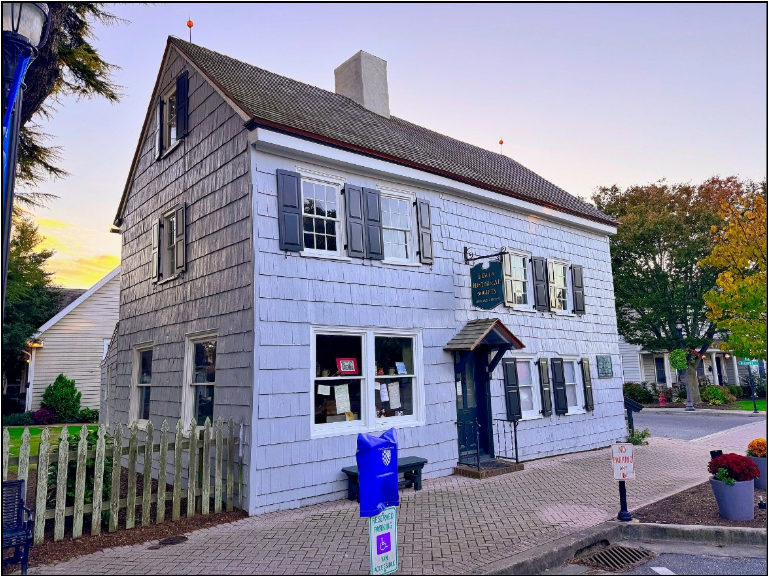
Ryves Holt House, built 1665, now owned by Historic Lewes. Courtesy of Harrison Keely.
How Did Lewes Become Part of William Penn’s Land Grant?
By 1664, King Charles II of England had taken control of the area, granting a large tract of land that included Delaware to his brother James, the Duke of York. The Duke renamed the area surrounding present-day Lewes Deale County and expanded agricultural production—including tobacco, pork, and corn—with much of the produce exported to Britain.
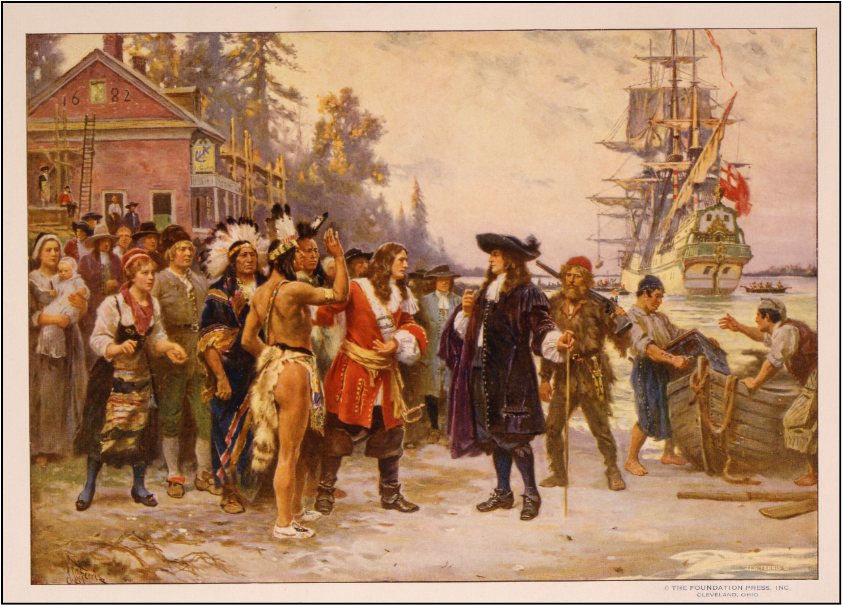
In 1681, King Charles granted William Penn the charter to a massive tract on the western side of the Delaware River, extending just north of present-day New Castle, Delaware. The next year, the king granted Penn a deed to the “lower counties of Delaware.” This additional grant was in payment of a royal debt, giving the Pennsylvania colony much-needed, easy access to the Atlantic Ocean via the Delaware Bay.
Painting depicting William Penn’s landing at New Castle, Delaware, 1682. Courtesy Library of Congress.
Penn subsequently renamed Deale County—the southernmost county—to Sussex County, and changed Hoernkills to Lewes, honoring the town of Lewes in Sussex County, England.
How Did Delaware Separate from Pennsylvania in 1776?
Relations between Delaware and its governor, William Penn, were frequently strained. Penn envisioned a strictly Quaker colony, but the inhabitants of Delaware were ethnically and religiously diverse, strongly resisting being governed as Pennsylvanians.
In 1704, a separate assembly was formed. This established the Delaware colony and enabled Delawareans to govern themselves, though they still shared a governor with Pennsylvania.
Delaware state seal. Courtesy of Wikimedia Commons.
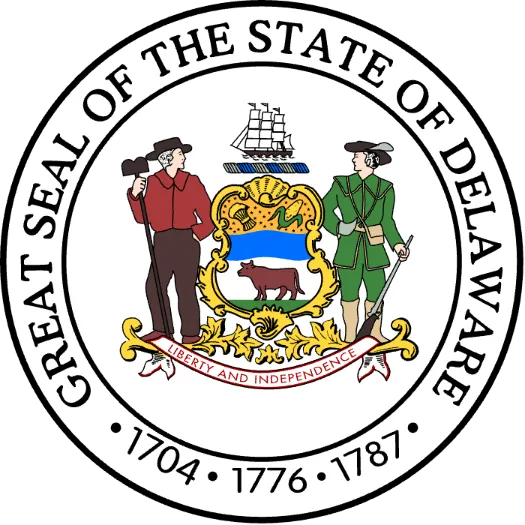
On June 15, 1776, Delaware officially declared itself a separate state—independent from both the British Crown and the Pennsylvania colony. Three months later, the state of Delaware drafted its own Declaration of Rights.
What Role Did Lewes Play During the American Revolution?
The first ships of the Continental Navy assembled in Lewes in February 1776, including the 30-gun flagship, the Alfred. Lewes supplied many of the sailors manning the newly formed navy's fleet. The town was also home to the highly skilled river pilots required to guide large warships through the shallow, treacherous waters of the Delaware Bay and River up to Philadelphia, the seat of the colonial government.
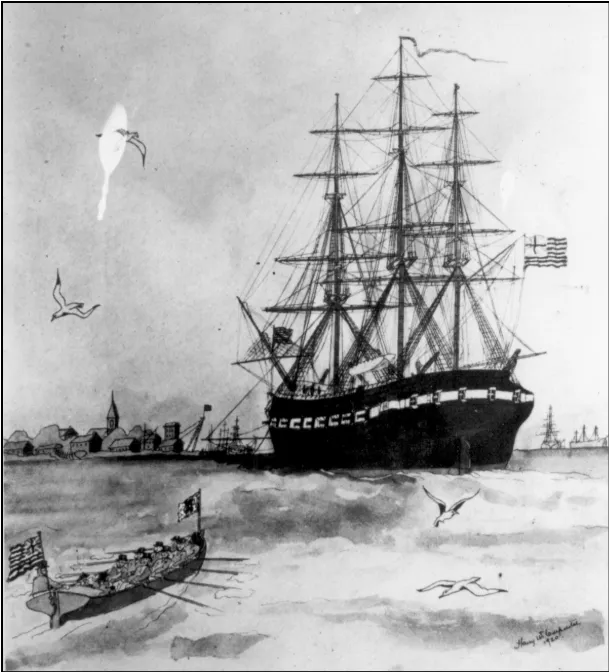
The Alfred, 30-gun flagship of the Continental Navy. Courtesy of Wikimedia Commons.
Lewes resident and pilot boat captain Henry Fisher actively spied on British naval movements in the Delaware Bay. He established a highly efficient series of relay stations starting from Cape Henlopen Lighthouse at Lewes and extending up the Delaware coast. This network passed critical intelligence on the Royal Navy’s movements to the colonial government in Philadelphia and relayed counter-intelligence to American vessels.
In response, the Royal Navy warship H.M.S. Roebuck led a British blockade of the Delaware Bay in 1776 to disrupt rebel activity, seize American boats, and capture these vital river pilots.
Caesar Rodney's Historic Ride
Due to localized conflicts in Lewes between patriots and British loyalists, Caesar Rodney—a militia leader and member of the Delaware colonial assembly—nearly missed voting for the Declaration of Independence. With the other two Delaware delegates locked in a bitter stalemate, Rodney rode through the night on horseback during a violent thunderstorm. He covered the 80 miles from Dover to Philadelphia just in time to cast his decisive vote for independence on July 4, 1776.
The War of 1812 and the Cannonball House
Although only one Revolutionary War battle was fought on Delaware soil (the Battle of Cooch’s Bridge near Newark), Lewes later came under direct bombardment by the British during the War of 1812. The Cannonball House, currently a museum owned by Historic Lewes, still stands today after a British cannonball struck its foundation. While the actual cannonball is safely on display inside, a replica remains embedded in the house’s foundation where the strike occurred.
Why Is Delaware Called “The First State”?
Delaware became the very first state to ratify the new Constitution of the United States on December 7, 1787, proudly claiming the title of The First State. Because its 1631 Dutch settlement was the earliest European footprint in the region, Lewes officially calls itself The First Town in the First State.
What Historical Records Are Available for Lewes, Delaware Research?
If you have ancestors from Lewes or the surrounding Sussex County area, these premier resources can help you uncover your family history:
Historic Lewes – Formerly the Lewes Historical Society, this entity maintains a network of thirteen historical properties, many of which have been relocated to the Historic Lewes Town Campus. The properties host museums, educational programs, and extensive artifact collections.
Lewes History Museum & Archives (101 Adams Avenue) – In addition to rotating historical exhibits, this museum houses a vast collection of family files, historic documents, and photographs. Research can be accessed by appointment through the Sally Mott Freeman Reading Room.
Sussex County Genealogical Society – The society sponsors guest speakers and educational presentations hosted at the Lewes Public Library and via Zoom. They also host a monthly Genealogy in Residence program at the Lewes History Museum to guide researchers tracking Delaware ancestors.
Historic Lewes Graves Database – An online, searchable database containing information on roughly 10,000 graves located across Delaware, featuring headstone photographs.
Delaware Public Archives (121 Martin Luther King Jr. Blvd., Dover, DE) – Located in Dover (40 miles north of Lewes), the state archives contain thousands of primary source documents, including vital records, land deeds, and historical census data. In-person research at their reading room is encouraged by appointment, and several collections have been digitized for online access.
Sources:
Lu Ann De Cunzo, “Lower Delaware Colonies (1609–1704),” The Encyclopedia of Greater Philadelphia (https://philadelphiaencyclopedia.org/essays/lower-delaware-colonies/: accessed 20 May 2026).
“Delaware,” History.com (https://www.history.com/articles/delaware: accessed 20 May 2026).
“Caesar Who? The Founding Father You’ve Never Heard Of,” History.com (https://www.history.com/articles/founding-father-you-never-heard-of-caesar-rodney: accessed 20 May 2026).
William H.J. Manthorpe, “Lewes During the Revolution,” pts. 1 & 2, Cape Gazette (Lewes, Delaware), 3 April 2026 and 1 May 2026 (https://www.capegazette.com/article/lewes-during-revolution-part-1/302498: accessed 20 May 2026).
Ronald K.L. Collins and Amy Marasco, “250 Years Ago the Seeds of Dissent Stirred in Lewes,” National Constitution Center Blog (https://constitutioncenter.org/blog/250-years-ago-the-seeds-of-dissent-stirred-in-lewes-de: accessed 20 May 2026).
“Hearty in the Cause: Defending the Delaware Bay, Spring 1776,” Journal of the American Revolution (https://allthingsliberty.com/2022/03/hearty-in-the-cause-defending-delaware-bay-spring-1776/: accessed 20 May 2026).
“Lewes, Delaware: History,” Wikipedia (https://en.wikipedia.org/wiki/Lewes,_Delaware: accessed 20 May 2026).
“Delaware Colony,” Wikipedia (https://en.wikipedia.org/wiki/Delaware_Colony: accessed 20 May 2026).
“History of Delaware,” Wikipedia (https://en.wikipedia.org/wiki/History_of_Delaware: accessed 20 May 2026).
I have been searching for a researcher who knows the ropes regarding the colonial Maryland and Eastern Shore of colonial virginia. I have
one line of Ancesters who lived in that area for 5 generations. I have not been able to have any luck on Burial Sites and Cementaries. Do you have any leads?
Hi Robert! Our researchers help with this all the time! Hi Florence! Someone from our team will be reaching out to see how we can further assist you!
My family came to USA in 1628. Rev / Lt. William Spencer had a B A from Cambridge University and arrived that year. His Wife was Lady Agnes Harris. William started the ?Hooks & Swords army safety group in Cambridge, Mass and completed his Masters degree at Harvard University. However about 1630 He and his family moved with 40 other families to Dartmouth Conn. They founded Dartmouth. Rev Spencer became a Selectman in the Connecticut Colony legislature. There are a lot of his contributions to the legislature in print at Conn’s state library. About 100 years later when the USA was formed, his family walked from Mass. to PQ. They worked without pay there for 12 years and then were given 250 acres of land. Many of them still farm there but some returned to the USA.
What a great story! Thanks for taking the time to comment!