
Many of our ancestors did not immigrate to the United States alone. Instead, they traveled with relatives, neighbors, or others from the same village, then settled near those familiar faces once they arrived. Historians often refer to this pattern as chain migration, and it helped immigrants build new lives while preserving the language, traditions, and customs they had left behind.
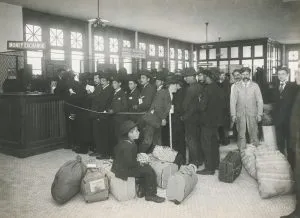 Ellis Island, United States
Across the United States, these settlement patterns shaped entire neighborhoods, towns, and communities. Some became well-known ethnic enclaves like New York City’s Little Italy or San Francisco’s Chinatown. Others were much smaller communities built around a local church, mill, mine, or logging camp.
Many of these historic immigrant towns and ethnic neighborhoods still preserve churches, cemeteries, newspapers, and other records that can help researchers trace their ancestors back to their homeland.
For genealogists, these communities offer something even more valuable than history—they provide clues. When an ancestor’s records seem to end, researching the people who lived around them can reveal where they came from and even connect you to relatives you never knew existed.
At Legacy Tree Genealogists, we often look beyond a single ancestor when researching immigrant families. The people who settled nearby can provide clues that direct records never reveal. The story below shows how researching one immigrant community helped connect two families whose lives were linked long before they arrived in the United States.
Why immigrants settled together
Leaving home for another country was rarely easy. Many immigrants chose destinations where they already had family members, friends, or neighbors who could help them find work, housing, and community.
These settlements often shared:
- Places of worship
- Native-language newspapers
- Cultural organizations
- Businesses owned by fellow immigrants
- Schools and social clubs
- Occupations common among people from the same region
German immigrants, for example, published dozens of German-language newspapers throughout the United States. Italian, Polish, Chinese, Scandinavian, and many other immigrant groups built neighborhoods where familiar traditions continued for generations.
These close-knit communities also created valuable records that can still help researchers today.
Historic Immigrant Communities and Towns Across the United States
While some immigrant communities became well-known neighborhoods in major cities, others developed into small towns centered around farming, mining, logging, or religious communities. Many of these places still celebrate their cultural heritage today and preserve records that can be invaluable for genealogy research.
A few examples include:
- New York City’s Little Italy became home to thousands of Italian immigrants who established businesses, churches, and social organizations that reflected the traditions of southern Italy.
- San Francisco’s Chinatown, established during the California Gold Rush, remains one of the oldest and largest Chinese communities in North America.
- New Glarus, Wisconsin, founded by Swiss immigrants in 1845, still embraces Swiss architecture, festivals, and customs.
- Lindsborg, Kansas, often called “Little Sweden,” was settled by Swedish immigrants who built Lutheran churches, schools, and cultural institutions that continue to celebrate their heritage.
- Pennsylvania Dutch Country reflects the legacy of German-speaking immigrants, many of whom belonged to religious groups such as the Amish, Mennonites, and Brethren. Their churches, cemeteries, and community records continue to provide valuable resources for family historians.
Whether your ancestors settled in a bustling city neighborhood or a small rural community, the people around them often shared a common language, culture, faith, or hometown. Those connections can become powerful clues when tracing an immigrant family’s journey.
Why Community Matters in Genealogy Research
Records to Look for in Immigrant Communities
When researching immigrant ancestors, it is easy to focus only on direct family members. However, sometimes the people living next door hold the missing piece of the puzzle.
Professional genealogists often use a technique known as cluster research, which examines an ancestor’s friends, neighbors, witnesses, church members, and business associates. These individuals frequently immigrated from the same hometown or region and may appear together in passenger lists, naturalization records, church registers, or local newspapers.
Sometimes your ancestor’s birthplace isn’t recorded anywhere, but a neighbor’s is.
That single clue can open an entirely new path for research.
Records to Look for in Immigrant Communities
Immigrant communities often left behind records that extend well beyond federal census records. Exploring these local resources can reveal an ancestor’s hometown, religious affiliation, family connections, or migration path.
When researching an immigrant community, be sure to look for:
- Church records: Baptisms, marriages, funerals, and membership records often identify an immigrant’s hometown or parish.
- Ethnic newspapers: Community newspapers frequently published obituaries, anniversary announcements, business advertisements, and news from readers’ home countries.
- Naturalization records: These records may include an immigrant’s birthplace, arrival information, and witnesses who were friends or relatives from the same community.
- Cemeteries and gravestones: Inscriptions sometimes include birthplaces, native-language text, or family relationships that don’t appear in other records.
- Local histories and community organizations: Historical societies, fraternal organizations, and ethnic associations often documented the families who helped establish immigrant communities.
These records, combined with traditional genealogy sources, can provide the context needed to break through a difficult research problem.
A Polish Community in Washington State
While large immigrant communities are often the most well known, similar settlement patterns developed in smaller towns across the country. One family story from Washington State illustrates how researching an immigrant community can reveal connections that span both continents.
In 1920, twenty-year-old William Paulis lived with his parents and siblings in Walville, where he worked as a lumberjack alongside his father. The family had immigrated from Poland, while the younger children had already been born in Washington.
Just nine miles away, twelve-year-old Laura Pierog lived with her parents and siblings in Doty. Like the Paulis family, the Pierogs were Polish immigrants connected to the logging industry. Laura’s father worked in a nearby sawmill.
At first glance, these appear to be two unrelated immigrant families living in neighboring communities.
Only after examining additional records does a larger story begin to emerge.
Following the Records Back to Poland
Marriage records for Laura’s parents identified their hometowns as Lipnik and Łąskówka in Galicia.
William’s naturalization records later identified his birthplace as Szklary.
When these locations are plotted on a map of present-day Poland, something remarkable becomes clear.
The villages are less than four miles apart.
Without researching the surrounding community, this connection may never have been discovered.
In other words, two families who lived only a few miles from one another in Washington had also lived only a few miles from one another before emigrating to North America.
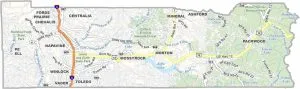 Lewis County, Washington
Even their occupations reflected the environments they chose. Both regions were heavily forested, and both families continued working in the logging industry after settling in the Pacific Northwest.
Whether the families knew one another before immigrating cannot be proven. However, the evidence strongly suggests they came from the same local community and recreated a familiar way of life after settling in Washington.
When Community Becomes Family
The story came full circle in 1923.
William Paulis married Laura Pierog in Lewis County, Washington.
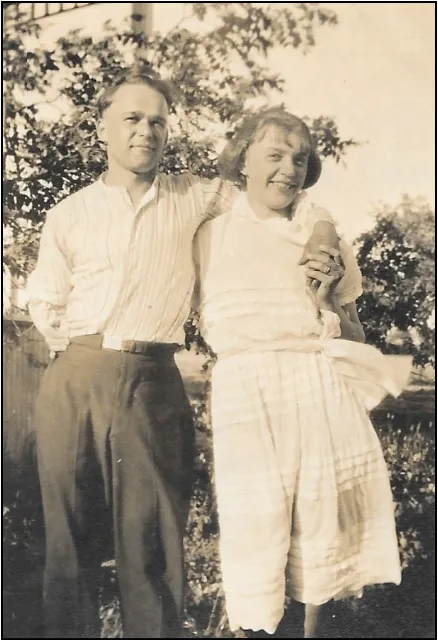
William Paulis (1900-1947) and Lauranarda Constance Pierog (1907-1996). William was born in Szklary, Rzeszow, Poland, and Lauranarda was born in Washington, a daughter of immigrants from Harta, Brzozow, Podkarpackie, Poland.
Two families whose roots stretched back to neighboring villages in southern Poland were united through marriage after building new lives in the Pacific Northwest.
Today, many of William and Laura’s descendants still live in the region where those early Polish settlements once flourished.
Their story illustrates how immigrant communities often preserved more than language and tradition—they preserved lifelong connections that crossed an ocean.
What This Means for Your Own Family History
If you’ve reached a brick wall in your family history research, don’t stop with your direct ancestor. Research neighbors, church members, marriage witnesses, fellow immigrants, and local ethnic communities. These connections often reveal details that your ancestor’s own records never recorded.
To better understand the broader history behind your family’s journey, explore our article Immigration: An American Heritage, which examines the many waves of immigration that helped shape the United States.
If you’re ready to begin tracing your own immigrant ancestors, our guide 15 Steps to Finding Your Immigrant Ancestors walks through practical strategies for following your family from U.S. records back to their country of origin.
Conclusion
Immigrant communities helped shape the United States, but they also preserved connections to the places immigrants left behind. Those connections remain visible in historical records today.
Whether your ancestors settled in a bustling city neighborhood or a small rural community, understanding the people around them can provide valuable clues about their origins and migration journey.
Every immigrant family has a unique story. Sometimes the key to discovering it isn’t found in your ancestor’s records, but in the community they built around themselves after arriving in America.
If you’re researching your own immigrant ancestors, we recommend starting with our guide, 15 Steps to Finding Your Immigrant Ancestors, for practical research strategies. And if you’ve exhausted the available records or reached a dead end, our team of professional genealogists can help uncover the communities, records, and connections that bring your family’s story into focus.
Leave a Reply